What is B2B CRM? How is it different from B2C CRM?
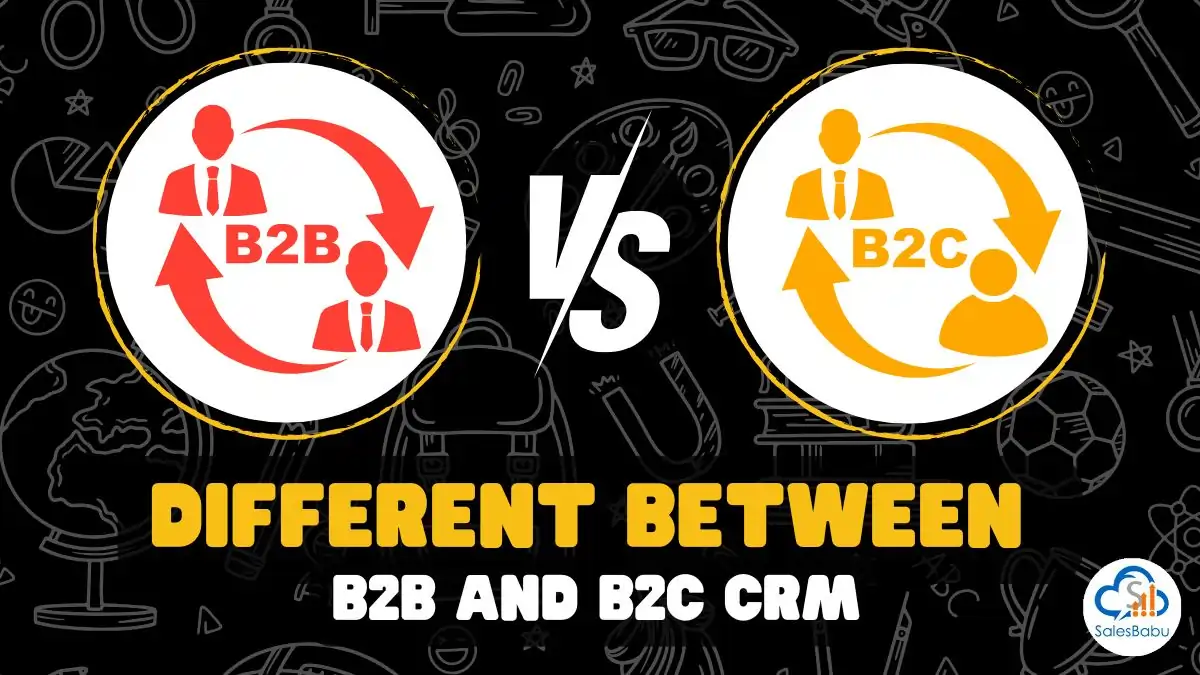
Customer Relationship Management – CRM system is most required in any company to streamline the sales and marketing team and help them to reach their target set goals. B2B CRM is for the companies who are into the process of directly dealing with business to business. Whereas, B2C CRM is helping the companies who are dealing with direct consumers and they focus more on the increase of the footfalls directly to their company’s or stores.
The nature of business and the customer’s interaction differs as per the company process and dealing with them helps to decide the most suitable CRM system for the company. Company requires a proper streamlining CRM application for the sales process and access to the CRM by sales people from anywhere, anytime, so that the sales force team and other department employees are having teamwork and aiming for the business sales revenue growth.
Both kinds of companies – B2B & B2C sales processes are having a high importance on sales revenue, customer service strengthening, managing their sales funnel, increasing customer engagement, managing the loyal customers and adding new customers, managing support tickets, etc. Moreover they require other sales related tools to be integrated with the CRM for the chat, surveys and better sales analytics helping the management to important business related decisions.
The right CRM is the one that fits how your customer actually buys. Know your customer B2B or B2C and you’ll know exactly which CRM you need.
Read our blog
What is Business to Business (B2B)?
Business to Business (B2B) is a transaction between two businesses. A primary company who is a manufacturer or a wholesaler involved in selling to another company, who is willing to purchase the product or service from a primary company.
B2B sales process which takes a long time, interaction with the company which involves frequent visits and it is a long process. Decision and approval is taken by the different management entities before procuring the materials.
To understand more on the business to business – b2b, then please refer below mentioned scenarios.
- A company who is procuring raw materials for the production process from the primary company
- A company who needed services for an operational purpose from another company who provides the services.
- A business enterprise who is into the re-selling of products or services produced the principal company and sold it to another company who wanted the said product or services.

What is Business to Consumer (B2C)?
Business to consumer (B2C) is to sell a product or services to an individual consumer, which is known as retail business. Selling the products or services to the targeted consumers who either visit the retail store to buy product or place an order over an e-commerce portal to buy a TV, Bike, Refrigerator, Consumer goods, pest control service, packers and movers service for house shifting.
B2C sales process is of short time and decision making is short period and taken fast.
Read our blog
How B2B and B2C Sales Cycles Work Side by Side
B2B Sales Journey
- Lead identified — company research begins
- First contact / cold call / email outreach
- Product demo or presentation
- Technical evaluation / trial period
- Quotation shared ? negotiation begins
- Revised quotation / commercial discussion
- Approval from finance / management
- Purchase order raised ? deal closed
- Onboarding / implementation
B2C Sales Journey
- Customer sees an ad or searches online
- Visits website or store
- Browses product / reads reviews
- Adds to cart / asks for price
- Decides and buys (or leaves)
- Receives product / uses service
- Leaves review / refers friends
- May or may not return to buy again
14-Point Comparison: B2B CRM vs B2C CRM
Here’s a clear, detailed comparison of how B2B and B2C CRM differ across every dimension that matters:
| Feature / Dimension | B2B CRM | B2C CRM |
|---|---|---|
| Number of leads | Fewer Fewer leads, but each is very high value. Every lead matters, losing one can mean losing lakhs. | High Volume Hundreds or thousands of leads daily. Focus is on capturing and converting at scale. |
| How contacts are managed | Multiple contacts within one company account manager, purchase team, finance, CTO, all tracked under one account. | Each individual consumer is one contact. No account-level hierarchy needed. |
| Decision-making speed | Slow Takes weeks to months. Multiple stakeholders need to agree before any purchase happens. | Fast Individual decides quickly, sometimes in minutes. Emotion and price drive the decision. |
| Lead sources | Fewer, more specific sources, referrals, LinkedIn, trade events, inbound website queries. Duplicate leads are easy to track and eliminate. | Multiple sources ads, social media, walk-ins, campaigns, referrals often simultaneously. Deduplication is a major challenge. |
| Email communication | One-to-one emails personalised, relationship-building messages to specific contacts at a company. | Bulk email campaigns to thousands of contacts promotional, seasonal, and triggered messaging. |
| Quotation management | Essential Generating quotes, proforma invoices, and final invoices is a core part of B2B sales. CRM tracks all versions of the quote. | Not typically needed. Prices are fixed and visible to all customers. |
| Sales activity tracking | Every call, visit, demo, email, and follow-up is logged and tracked. Sales managers need full visibility into every account. | Volume is too high for individual activity logs. Focus is on pipeline stage and conversion rate. |
| Marketing automation | Useful but not the primary focus. Mainly used for lead nurturing over long periods. | Critical Marketing automation is the heart of B2C CRM triggered campaigns, drip sequences, retargeting, and behavioural emails. |
| Phone / cloud telephony | Lower call volumes manageable by the sales team without special telephony integration. | Essential High inbound call volume needs cloud telephony integration to capture every lead automatically from calls. |
| Social media integration | Less critical. B2B buyers don’t typically buy through Instagram or Facebook ads. | Very Important B2C leads come from Facebook, Instagram, YouTube. CRM must capture and track these automatically. |
| Role of emotions in buying | Minimal purchases are driven by ROI, features, integration, and business need. Logic wins. | Very high, brand feeling, social proof, personal desire, and peer influence all play major roles. |
| Referral tracking | Referrals are trackable and important, word of mouth between businesses is powerful and specific. | Hard to track accurately at scale most B2C referrals happen through informal sharing and word of mouth. |
| Sales forecasting | More predictable, long cycle means you can see months ahead based on pipeline stage. | Less predictable, driven by seasonal demand, campaigns, and impulse. Hard to forecast individual behaviour. |
| Sales complexity | High Demos, technical evaluations, commercial negotiations, third-party integrations, legal reviews. | Simple Straightforward purchase path. Main goal is removing friction so the customer converts quickly. |
Examples :
B2B CRM
Suppose an organization is selling BI tools to other businesses. Its CRM will more likely have features for building profiles of the companies in its target audience and picking out key individuals in those companies. Sales reps and managers will follow the progression with company representatives through every stage to nurture each lead and take advantage of upselling and cross-sell opportunities.
If you are on the search for a CRM for B2B, here are a few specific capabilities you should be on the lookout for:
- Automation: Because leads are more valuable, losing even one or two can deal a major blow. The automated workflow will help your sales reps to manage their workloads to keep track of contact information so nothing important will slip through the cracks.
- Forecasting: Sales cycles are more expectable in B2B, making it very much easy to forecast growth based on previous performance. The goal is to precisely predict customer behavior and project financial outcomes.
- Enhanced tracking: B2B sales processes will cover more stages than B2C. To that end, the B2B CRM solutions will offer greater visibility into exactly what stage a prospect or lead is at.
- CPQ applications: These modules or integrations will allow B2B companies (and some B2C businesses) to more specifically sell complex, highly configurable products, such as industrial equipment. They are especially useful for organizations in a supply chain.
- Quote management: Generating quotes is a necessary part of the B2B sales process. Before a sale is finalized, the customer will need a breakdown of what their money is buying. Quote management software will allow your users to create a document that lays out the details and can help prevent order mistakes for complex purchases.
Distinguishing Between B2B and B2C Sales Processes
B2B (Business-to-Business) and B2C (Business-to-Consumer) operations demonstrate inherent variation in their business dynamics. In B2B, the significance is on corporate accounts, while in B2C, the emphasis is on individual consumers.
The moment when a company and its salesforce interacts with customers, these customers may either be individual consumers or organizations. However, the fundamental sales process remains consistent, there are subtle distinctions between the two.
In B2B sales, the primary goal is to sell products or services to compact and mid-sized industries, which are considered as the main accounts by the sales team. The time when a company secures an order from these customers, it evidences the institution of an account, with the anticipation of repeating orders from such loyal clients in the future.
Contrarily, the B2C sales process focuses on selling products or services to individual consumers. In such a scenario, the salesperson’s communication with clients is mostly less extensive, as they must serve a broader client base, including those who have occasional or infrequent purchases. However, it could be challenging to recognise each customer upon their return to the store, the foremost goal is to meet the customer’s immediate requirements and garner positive feedback to assure customer satisfaction.
The difference between B2B and B2C, focus on the individual consumers is important but not like any key account companies.
Importance of CRM application for B2B and B2C customers
Companies who are into different vertical businesses and sales processes also differ, when it comes to B2B and B2C sales. When the company is into the contacts of companies and dealing into the sales of product or services, wherein the sales person is actively on a daily basis interacting with these companies, then b2b CRM to be implemented. Sales people whose responsibilities is to generate revenue by doing cold calling or work on the leads shared by the companies. Rigorous follow ups with the companies, sharing the necessary documents, explaining the product or service as per their necessity. Quotation to be given and if there is a detailed discussion on the pricing, where revised quotation is to be shared, which can be managed by the online CRM software. In the b2b CRM amendments of the quotations are recorded and useful during the sales process of closing the deal. On closure of the deal, sales orders are managed and status of the sales order are updated from time to time in the CRM system.

Read our blog
Whereas in B2C, small or large retail stores or companies who deal with the direct consumers to sell the products or services and number of customers interactions are in large numbers every day. When the customers flow in immense and data is more, then the individual enquiries or leads assigning is difficult and managing the same becomes tedious. Hence b2c CRM helps to capture the individual customers’ data in one go and assigning also becomes smooth. Moreover the following up with them through the bulk emailing is possible by integrating with the cloud based CRM.
Handling the high volume data is possible in B2B CRM and B2C CRM, managing them and streamline the sales force team. To interact with every customer through the emailing one to one or in bulk, introducing the latest products and its features wherein they may come back to the company for repeat purchase. Moreover providing both kinds of customers a good customer service, making them loyal customers and expecting a word of mouth from them is certain.
Sales Cycle Prediction
When we analyse the sales cycle between the B2B and B2C, it is unpredictable of the b2b sales cycle. In b2c the sales cycle is a very short period and does not long for much time. Whereas the b2b sales cycle tends to be complex and time taken is long. It involves the approval from many stakeholders. It has a process of demonstrating the working of a product or a solution, technical discussion, commercial review and also if any integration with the third party solutions. On completion of the said process of order placing will happen. With the help of online CRM software, a complete sales cycle process can be managed and streamlining the sales team is also possible.
Find the Right CRM for Your Business, B2B or B2C
SalesBabu CRM is built for businesses with dedicated B2B features for complex sales cycles and B2C capabilities for high-volume lead management. Get your free demo today.
Conclusion
Customer centricity is increasing the productivity of a company and business processes which are involved in sales, support and marketing to be streamlined. CRM for B2B and B2C sales processes helps the companies to build a good relationship, make them loyal and focus on retaining existing and new customers. Customer loyalty and sales revenue is the growth of a company. SalesBabu CRM helps to improve and organize the business information in a systematic manner. It is enhancing the better communication within the team, automating the daily sales tasks and providing the better efficiency in the team. Providing the analytical data and getting the MIS reports to help management to make better and accurate important decisions for improving the business.
Frequently Asked Questions
What is B2B CRM software?
B2B CRM is software designed for companies that sell products or services to other businesses. It helps manage long, complex sales cycles, tracking multiple contacts within a single company account, managing quotations and proposals, scheduling follow-ups, and monitoring deal progress across months. B2B CRM focuses on building and maintaining deep, long-term relationships with a smaller number of high-value business accounts.
What is the key difference between B2B and B2C CRM?
B2B CRM manages fewer but higher-value accounts with long sales cycles, multiple decision makers, and detailed quotation management. B2C CRM manages thousands of individual consumer leads with short sales cycles, faster decision making, and bulk email and SMS campaigns. B2B CRM focuses on account-level relationships and detailed sales activity tracking. B2C CRM focuses on volume lead management, marketing automation, and fast conversion. Both need a CRM but they need very different features.
Which CRM does a small business need B2B or B2C?
It depends entirely on who your customer is. If you sell to other businesses (manufacturers, wholesalers, distributors, IT companies, service firms), you need a B2B CRM with features like account management, quotation tracking, and long-cycle pipeline management. If you sell directly to individual customers (retail, e-commerce, consumer services), you need a B2C CRM with bulk campaigns and high-volume lead management. Some businesses do both in that case, SalesBabu CRM can help you find the right configuration.
Why is the B2B sales cycle longer than B2C in India?
B2B purchases involve multiple stakeholders, the department head who needs the product, the IT team who evaluates it technically, the finance team who approves the budget, and sometimes the management or board. Each person has different concerns and needs to be convinced. The process includes product demos, technical evaluations, commercial negotiations, legal review, and final approvals, which collectively take weeks or months. B2C decisions are made by a single person, often in minutes or days, based on price, reviews, and personal need.
What CRM features are most important for B2B companies in India?
For B2B companies, the most important CRM features are: multi-contact account management (tracking multiple people within one company), quotation and proforma invoice generation, detailed sales pipeline tracking across long sales cycles, follow-up reminders and complete activity history, competitor intelligence capture, and sales forecasting. For B2B businesses specifically, having the CRM accessible on mobile (for field sales teams), and integration with email for one-to-one communication are also very important. SalesBabu CRM covers all of these.