Purchase Planning With Efficient Inventory Management System
Ask any business owner what keeps them up at night, and stock trouble is usually somewhere on that list. Either too much cash is sitting in a warehouse as unsold stock, or a customer’s order is stuck because a key part never got ordered in time.
Both problems trace back to the same root cause. Purchase planning was either missing, or it was done on gut feeling instead of real numbers.
Purchase planning isn’t glamorous. It rarely gets discussed the way sales or marketing does. But get it right, and your working capital stays healthy, your suppliers stay reliable, and your customers get their orders on time. Get it wrong, and none of those three things happen consistently.
This guide walks through what purchase planning actually means, why it matters for manufacturing and trading businesses, and how a proper inventory management system makes the whole process far less chaotic than spreadsheets and phone calls to vendors.
What Is Purchase Planning?
Purchase planning is the process of deciding what to buy, how much of it, and when to buy it. It also means deciding which supplier to buy from, so your business always has the right stock without tying up too much money in it.
In plain terms, it answers four questions before you place any order:
- What do we actually need?
- How much of it?
- When do we need it by?
- Who should we buy it from?
Get these four answers right, consistently, and your stock levels stay healthy on their own. Get them wrong, and you swing between two expensive problems, dead stock gathering dust, or stockouts that cost you a sale.
Why Purchase Planning Matters for Manufacturing and Trading Businesses
Manufacturing and trading businesses feel the impact of purchase planning more sharply than most. Raw material and stock availability directly decides whether they can fulfil an order at all.
A manufacturer without proper purchase planning runs into one of two problems. Either they run out of a key raw material mid-production, delaying every order behind it or they end up with excess raw material sitting unused, quietly eating into working capital.
A trading or distribution business faces a slightly different version of the same problem. Order the wrong products, or too much of the wrong products, and money gets locked into stock that customers aren’t actually asking for.
Good purchase planning also protects something easy to overlook — your relationship with suppliers. A business that orders in a predictable, well-planned rhythm is a far easier partner to work with than one that panic-orders at the last minute. Suppliers tend to prioritise the customers who make their own planning easier.
Purchase Planning vs Procurement vs Inventory Management
These three terms get used almost interchangeably in everyday conversation, and that causes real confusion. Here’s a simple way to think about how they connect.
| Term | What It Covers | Where It Sits |
|---|---|---|
| Procurement | The entire journey of acquiring goods — from identifying a need to final payment | The broadest umbrella term |
| Purchase Planning | Deciding what to buy, how much, and when | Sits inside procurement |
| Inventory Management | Tracking and controlling stock you already have, once it’s arrived | Runs alongside purchase planning |
Purchase planning without good inventory data is really just guessing. And inventory management without purchase planning means you’re always reacting to stock problems instead of preventing them. The two work properly only when they talk to each other ideally through the same software.
The Core Elements of Every Purchase Decision
Before you place a single order, a few core questions decide whether that purchase actually helps your business or quietly hurts it.
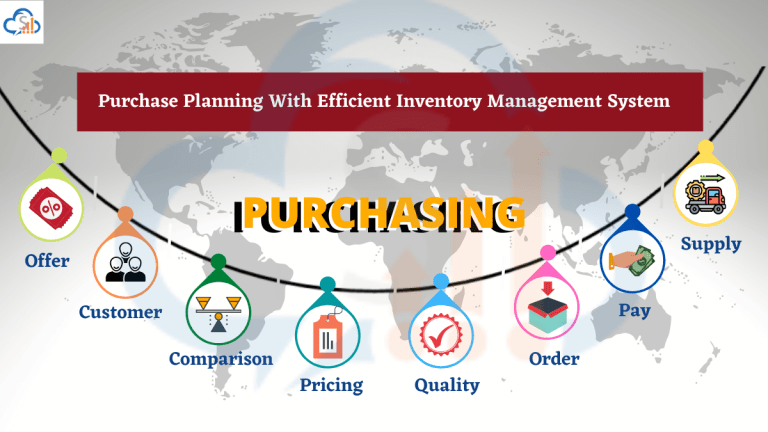
- Source : which supplier you’re buying from, and how reliable they’ve been in the past.
- Price : not just the unit cost, but whether bulk pricing genuinely saves money once you account for the extra stock sitting unused.
- Quantity : enough to avoid a stockout, without so much that it becomes dead stock.
- Quality : the goods actually meet your specifications consistently, not just on the first order.
- Timing : the order lands with enough lead time to avoid a delay, but not so early that it ties up storage space unnecessarily.
- Location : where the stock needs to reach, particularly relevant if your business operates across multiple warehouses or branches.
Get any one of these wrong consistently, and it shows up eventually — either as a stockout, or as a warehouse full of stock nobody is buying.
Key Factors That Shape Your Purchase Planning Strategy
A good purchase plan isn’t built in isolation. It has to balance a few real, sometimes competing, business priorities.
Business needs come first. Serving customers reliably matters, but overstocking to be extra safe quietly decreases your working capital. It can also leave you with obsolete stock that eats into profit instead of protecting it.
Warehousing and storage capacity matter just as much. Storage has its own ongoing cost — staff, space, and upkeep. A purchase plan that ignores your actual storage capacity ends up creating a second problem while solving the first.
Customer needs sit at the centre of all of this. If you’re part of a larger supply chain, your customers are counting on consistent stock availability. That reliability is often what keeps them coming back, more than price alone.
Supplier lead time deserves its own place on this list too. A supplier who takes three weeks to deliver needs a very different reorder timeline than one who delivers in three days. Treating every supplier the same way is a common, avoidable mistake.

Major obstacles in purchase planning process
How to do Purchase Planning?
Purchase planning for either manufacturing unit or wholesale or trading unit operation is an important process. Purchasing of the raw materials or goods is to maintain the stock levels. Stock which is required to be maintained in the inventory software, but overstocking or excess of the goods will have a negative impact on the business profits. When purchasing and ordering enough stock, take the benefits of bulk discounts, but balance the inventory and do not over stock.
Read our blog
How to handle & plan Work orders?
Handling the Inventory and tracking of the work order is to keep track of fixed assets, have control on the working capital. Inventory control software will help to get the project costing and the inventory related to the said project.
How to handle Vendors?
Vendor handling is a structured process, wherein the suppliers can be managed by the buyer’s and improve the relationship. Here the deliverables are managed with the vendor, managing compliance, invoices and payments – a work collaboration of the purchase department and vendor.
How to do Product Mapping?
A product mapping is to reduce costing, reduce the storage needs and streamlining the ordering process.
How to do vendor tagging?
Keep the track of inventory, which is important and able to control costs by keeping the inventory software updated. Through the Inventory management system, discovering any kind of discrepancies between inventory results shown related to the vendor tagged products in the software and the physical count.
How to Float Purchase Inquiries?
Purchase inquiry is floated for the requirements necessary in the company. It is raised for a product requirement and interested vendors come up with their proposal to the organisation.

How to handle Vendors Purchase Quotation?
Vendors have provided a quotation to the company for the supply of necessary goods.
How can Compare Vendor Quotation?
When the company receives multiple purchase quotations for the similar products from multiple suppliers, then in inventory management software it is easy to do the comparison and select the best purchase quote.
How to handle Purchase Orders?
Officially the confirmation document is issued by a buyer to the Supplier mentioning the requirement of the products mutually agreed prices.
Is it possible to handle all the Pending Purchase Plans on a single Computer screen?
Yes possible with the help of Inventory Control Software.
How to handle Pending Purchase orders with Vendors?
With the use of this MIS report, companies can see the purchase order status, what quantity is order placed, how many are invoiced and still how many yet to be received from the supplier against the PO issued.
How to increase Inventory Productivity?
In the Online Inventory Management Software, helping to do the reconciliation of the inventory. Through the inventory software, it eliminates the manual way of paper work and maintaining the records, but also streamlines the inventory process.
How to Handle Purchase Bills?
Purchase Invoice processing is handled by the accounts team, through reviewing over Inventory Management Software on the purchases done by the supplier. The process when a company receives goods and purchases a bill against the payment made.
How to handle entire Purchase Returns @ Single Screen?
In order to record the product return, which was purchased from the supplier, it can be done over a single screen. Checking the record and filtering the product when it was purchased.
How to handle material movement cycle?
Handling the material movement is possible with the Inventory software throughout the manufacturing, sales and distribution. During the process it helps in inventory management and product tracking purposes.
How to do Stock adjustment?
In the Inventory Management System, stock records with the actual findings of the physical inventory is stock adjustment. The adjustment of the stock either increasing or decreasing due to the inventory discrepancy in account of theft, loss, breakages or the errors in the physical number.
How to fill the Gap Between Purchase & Inventory Tier?
Gaps are areas where the price of a stock is showing up or down because of no or less business. This kind of gap between the purchase and inventory can be filled by stock optimization with the help of Inventory software.
How to Make Purchase Indent?
This is used internally by the company staff during the purchasing process, a request for the material before placing a purchase order to the supplier.
How to Check and Define Product Re-Order Levels?
In the online inventory management Software, inventory reorder level is shown, wherein the company will place a new order or start a production to maintain the stock. Reorder level is to maintain a safety stock.
In what ways do Businesses benefit from the Efficient Inventory management Systems?
It’s possible to expect phenomenal achievements in operations with a breath provided by modern inventory management systems. For example, SalesBabu CRM was used by a manufacturing company to send purchase orders and manage inventory in a way that was visible in the company’s CRM in real time. What did they manage to achieve? 30 % reduction in oversupply and greater cooperation with suppliers, since reconstructions were always made in a timely manner. These stories also bring forth the role that technology plays in the disconnection that is experienced between purchase planning and inventory control. It makes certain that operations run smoothly.

Benefits of SalesBabu Purchase Planner with Inventory On-Demand
- Effective Purchase planning
- Purchase Order Handling
- Enable to Float PI’s(Purchase Inquiries)
- Compare Multiple Quotation with Multiple Vendors
- Get Re-Order Level on Product and Raw Materials
- Handle entire Work Order
- Facilitates Job Work Scheduler Separately
- Enable to make P Q (Purchase Quotations)
- Enable to do multiple GRN against the Partial vendor Order
- Enable for Entire MRN(Material Receipt Note) on one screen
- Manage entire Vendor Bucket
- Get real time Inventory Updates on Stock
- Product Sampling
- Capture Sales Returns
- Vendor’s Mapping with Products
Read our blog
Main factors to be considered while developing a purchase planning
Business needs
Ensuring a solid flow of revenue through good customer relations can be important, but the business needs to be on a firm footing to be in a position to serve the customer. Overstocking will decrease working capital, potentially endangering the ability to grow and diversify. It might also lead to stock obsolescence, reducing profitability. The purchasing strategy, hence, needs to balance business needs against customer needs.
Warehousing and storage capabilities
Warehousing has its own carrying costs that are peripheral to core operations, like staffing and building service costs. It is necessary that the business makes full use of the facilities in order to increase revenue potential. The purchasing strategy should also take the maximum storage capacity into account – overstocking might reduce the available capacity, so orders should fit in with demand. Likewise, the business should be able to move well-stocked items to warehouses where there is a shortage to preserve storage space.
Customer needs
The customer is the primary consideration for any business; without customers, there is no revenue. In the wholesale distribution of goods, the customer is frequently part of a wider supply chain, so reliability is essential. Procurement planning needs to make sure that stock availability at all times, and this should be the main aim when purchasing.
Conclusion
Core Value of SalesBabu Inventory Software India is that it can track entire stock transactions at micro level and can provide real time inventory status on material. It allows companies to do Effective purchase planning against the stock requirements. Hence, SalesBabu inventory management software allows organization to Manage & synchronize entire Purchase Plans, Pending Purchases, Vendor & purchase Quotations and Purchase orders on single computer, which enables inventory manager to keep track of all the Stock Movement (Inward & outwards) and also reduces the operational cost.
To conclude, it is apparent that coming up with an efficient way of dealing with inventoriable goods is pivotal to the success of any business. Such endeavors can be effortlessly achieved by adoption of sophisticated technology such as the SalesBabu CRM tool which considerably reduces manual interventions, enables efficient planning and quick turnaround time in response to the dynamic market. Following the adoption of ICT as a whole in the present times leads to all companies operating a sturdy business model with measurable scalability in the subsequent periods to come.
SalesBabu Online Inventory Management System provides a robust purchase planner tool on a single screen, where companies can easily manage their purchase quotas, and can schedule their purchase plan effectively.
Get your Inventory Management Software Free trial today……