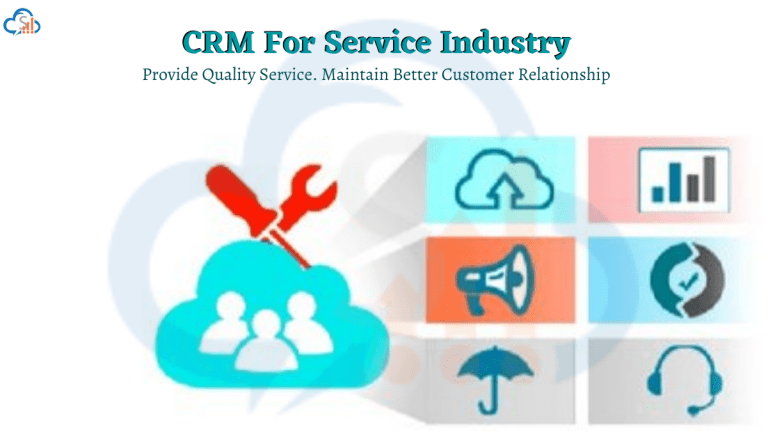
CRM for Service Industry
Think about the last time you called a company’s customer support. You explained your problem to one person. They put you on hold. They transferred you to someone else. You had to explain everything again. And then again to a third person.
Frustrating, right? That experience repeated millions of times every day. This happens when a service business doesn’t have a proper system.
A Service CRM fixes exactly this. It stores everything about every customer in one place, so your entire team sales, support, service engineers all see the same information. No more repeating. No more missed complaints. No more broken promises.
“The foundation of your company is customer satisfaction.” And in the service industry, satisfaction doesn’t come from what you sell, it comes from how well you support your customer after the sale.
What is a Service CRM and Why Does Your Business Need One?
A Service CRM is software that helps you manage everything that happens after a sale, complaints, service visits, warranties, SLAs, engineer scheduling, and customer communication all from one central platform.
In a regular business without a CRM, service teams manage all of this through phone calls, WhatsApp messages, Excel sheets, and sticky notes. This creates chaos missed complaints, duplicate service visits, engineers showing up without the right information, and customers waiting too long.
A Service CRM brings all of this under one roof. Every complaint is tracked. Every engineer has their schedule. Every warranty expiry is automatically flagged. Every customer interaction is stored so no matter who answers the call, they already know the full story.

Read More
Major Challenges in Service Industry And How CRM Solves Each One
How to manage customer escalations & complain?
Complaints get lost in WhatsApp, or nobody knows who’s responsible. CRM creates a ticket for every complaint, assigns it to the right person, and tracks it until resolution.
How to manage Service Level Agreement (SLA)?
You promise to resolve issues in 24 hours but have no system to track it. CRM tracks every ticket against your SLA deadline and alerts you before a breach happens.
Can we count the after sales support & service Earnings and expenditures?
How much revenue is your service department generating? Most businesses can’t answer that. CRM tracks all service revenue, AMC contracts, and spare parts billing in one place.
How to do prior scheduling for service Engineer’s work (Installations, product services)?
Engineers go to the wrong location, miss appointments, or arrive without the right parts. CRM gives every engineer a daily schedule on their phone with customer details, location, and job history.
How to manage all accounts at one place?
Customer data scattered across Excel sheets, emails, and WhatsApp. CRM centralises every customer account all contact details, past interactions, open tickets, and purchase history in one searchable database.
Is it possible to define Preventive Maintenance Services automatically?
You forget to schedule AMC visits or warranty reminders. CRM automatically triggers reminders and schedules preventive maintenance based on dates you define without any manual follow-up.
Benefits of CRM in Service Industry
Customer satisfaction proves to be a barometer for assessing the standard and quality of your services and the strength of your company’s relationship with its clientele. SalesBabu CRM helps in tracking this intangible information, makes customer requirements more predictable, and improves customer relationships. It also increases the quality and number of Clients in your Service Bucket.
Centralised Customer Contact Management
Organizations can deliver robust service to customers with the help of real time & centric databases; which can be operated from a single point.
Automated Service Scheduling and Reminders
CRM enables organizations to automate intimations about their job such as installation, warranty expires and PMS visits; so that you never miss any opportunity to improve their SLA.
Maximised Engineer Productivity
CRM enables service managers to view status of all the service activities, in terms of PMS, and after sales support. It also helps you to increase Support Engineer’s Productivity. One can manage long term customer relations by giving them good customer service.
Increase Customer Satisfaction
CRM helps you to enhance customer satisfaction, andto gather feedback from customers, analyzing and evaluating the responses to create customer satisfaction initiatives. Increased customer loyalty; result in increased revenue in terms of your Services.
Optimised Turnaround Time
You can define your Turnaround Time (TAT) depending on the distinct requirements of your services, resulting in better service levels and improved productivity between your service and support engineers. CRM tends to resolve the customer’s issues in a short period of time. It takes your customer services to different levels and helps you to give quality services & even you will be able to maintain consistency of the services.
Better After-Sales Revenue Tracking
Track every rupee from after-sales service, AMC revenue, repair charges, spare parts, extended warranties. Know which service contracts are up for renewal, which customers are overdue, and where your service revenue is coming from month by month.

Features of CRM for Service-based Industries
Unify Customer Interaction
Get quick access to contact information across numerous channels like telephone, email, live chat, and social media.
Simplify Billing and Payments with Invoices
Create invoices on the go and easily send them directly to customers with the Invoice integration. Replace your pen and paper with digital invoices. Create invoices directly from CRM and mark all the payment statuses to stay on top of your bills.
Maintain Service Catalogs
Build a catalog of your services inside CRM. Define each service, set dates and times for the availability of each and everyone, and assign staff to handle and deliver them.
Assign and Track Jobs
Jobs can be allocated to one or more members of the team. All the notifications are sent to the team members, alerting them of their newly allocated job. Customized sheets will guide your team to record all the required information before they mark their service as completed.
Read More
How a Service CRM works
So, let us check what are some of the primary elements of a service CRM system? First and foremost, customer’s information is captured by every department in the CRM ecosystem so that it can be accessible by the service team.
Customers can contact support through multiple channels like – online forms, email, phone call, chatting, and social media platform
Once a customer is able to establish a connection with the support and service desk, a ticket associated with their issue is created. In the ticket, all the essential pieces of information are captured such as customer details, the type of the complaint, and suggestions to whom the ticket should be assigned, for example, problems logging into an account might go-to the IT department; problems with delivery would go to shipping.
A service-level agreement (SLA) is also a key to any customer support and service. Therefore, a logged ticket might include details about SLA, which makes both support staff and customers aware of what to expect regarding how long it might take for the issue to be addressed and resolved.
Towards the various steps in resolution, a workflow helps to organize and automate the process. Like, if a damaged product is to be returned by the customer, a task should be triggered by a workflow for the inventory and shipping team to promptly mail out a replacement.
Finally, at a later stage, an online customer service CRM software can gather feedback about their service experience, which further boosts support quality for every future ticket. This is the complete process of a support and service process.
How CRMs Transform the Service Industry
Different service sectors face unique challenges. Here’s how CRM systems address them:
- Healthcare: Centralized patient records enable timely follow-ups and better care coordination.
- Hospitality: Real-time customer preferences help create memorable guest experiences.
- Education: Automated reminders for course enrollments and fee payments enhance student management.
By tailoring CRM features to industry needs, businesses can deliver exceptional service while reducing operational complexity.
Ready to Transform Your Service Business with CRM?
SalesBabu Service CRM helps businesses manage complaints, track SLAs, schedule engineers, and delight customers all from one simple platform. Get your free demo today.
Conclusion
There is no doubt that the service industry should implement a CRM system as it is now an essential component of the business strategy. Using SalesBabu CRM or similar solutions, Companies can improve customer satisfaction by eliminating time-consuming, repetitive work and providing meaningful information for better decision-making. With the change and uplift of consumer needs, there is a need for a strong CRM system that will ensure your service not only meets but also exceeds the expectations, thus keeping your business at par with the competition and all set for the future.